The short answer
You do not need a chimney. You need to choose between two things:
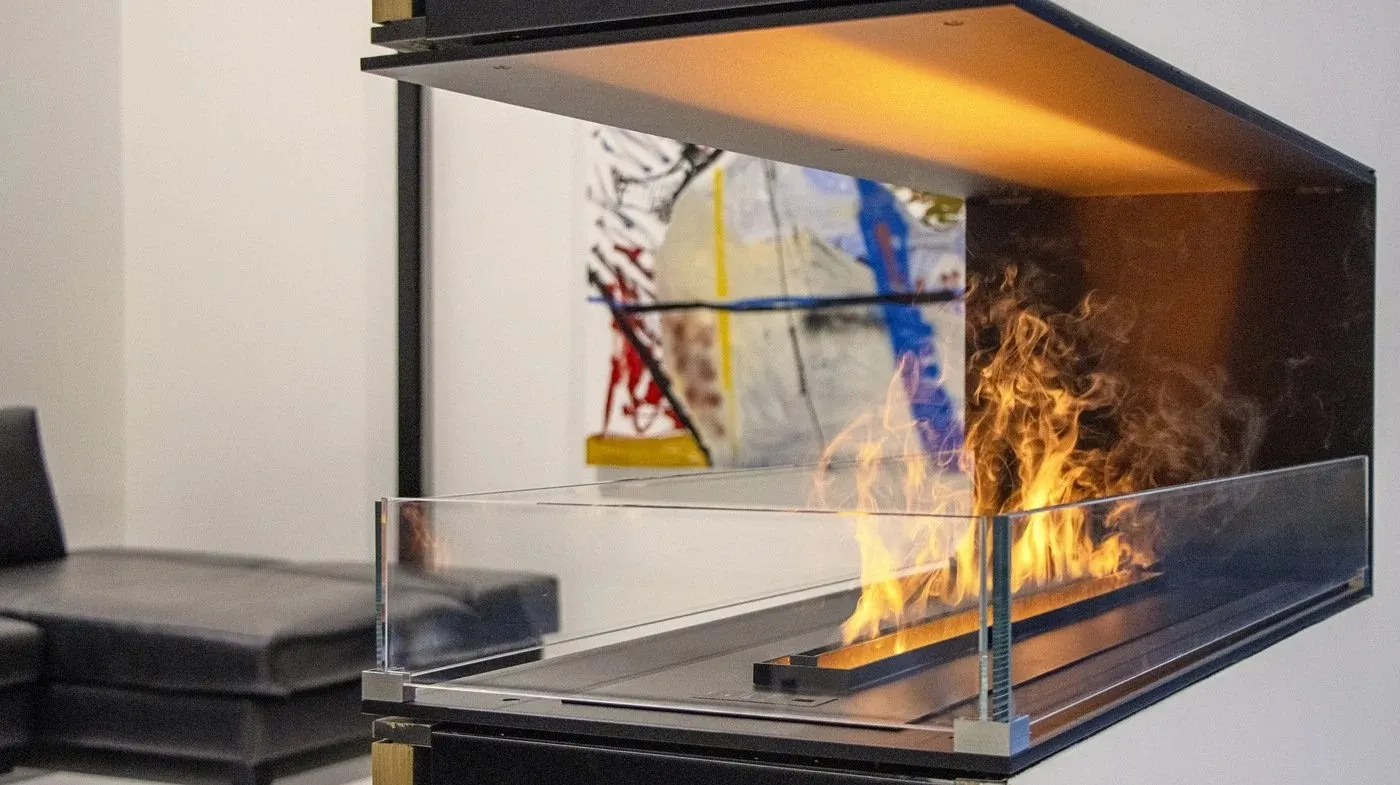
- A bioethanol fireplace, for a real flame with gentle warmth. It burns clean, so there is no smoke to carry away, but it is still a fire and needs air and a suitable room.
- A water vapour fireplace, for the look of flame with no fire and no heat. It needs power and demineralised water, nothing else, so it works where an open flame is not allowed.
Both are built to measure in Denmark, and both go into places a traditional fireplace never could: a wall, a divider, a ceiling, a table. This guide explains what each one needs from the room, so you can see which fits your home before the first conversation with us.
Why Gulf homes have no chimney, and why it no longer matters
A chimney exists to take away smoke, soot and gases from burning wood or gas. Villas in Dubai, Riyadh and Doha were designed for air conditioning, not for burning logs, so the chimney was never built. Apartments in towers have no route to the roof at all.
A bioethanol flame makes no smoke, no soot and no ash. A water vapour flame makes nothing at all, because nothing burns. So the one job a chimney does is not needed, and the fireplace becomes a piece of interior design rather than a piece of building work.
What about a gas fireplace without a chimney?
Many people search for a gas fireplace without a chimney, and the reason is clear: they want a real flame with no wood, no ash and no work on the roof. The idea is right, but a gas fireplace is still tied to the gas:
- It needs a gas line from the building or a cylinder, fitted by a licensed gas installer.
- Most gas models need a flue or a vent pipe through the wall. Even the ones sold as vent-free need the same gas connection.
- Many towers and communities do not allow a new gas line inside an apartment, and most need the management’s approval before any work.
- The fire stays where the pipe ends. If you change the majlis layout later, the flame cannot follow.
Decoflame does not make gas fireplaces. If what you want is a real flame with no chimney, bioethanol gives you that with no gas line, no gas installer and no flue, and the burner goes into the wall or the divider as it is. If the building does not allow open flames, a water vapour fireplace gives you the look of fire with no fire at all.
| Gas fireplace | Bioethanol | Water vapour | |
|---|---|---|---|
| Gas line | Yes | No | No |
| Licensed gas installer | Yes | No | No |
| Chimney or flue | Usually | No | No |
| Real flame | Yes | Yes | The look of a flame, no fire |
| Can move later | Hard | Possible with freestanding casings | Possible |
Option 1: bioethanol, the real flame
Bioethanol is a renewable, plant-based liquid fuel. In a Decoflame burner it gives a living, moving flame and a gentle radiant warmth, which is why it suits the majlis and the terrace from November to March.
What it asks of the room:
- Air, not a chimney. Any flame uses oxygen and releases a small amount of carbon dioxide, so the room is ventilated while the fire is lit, as with any open flame. Our automatic burners carry a CO₂ sensor, a spill sensor, an overheating sensor and an automatic emergency shut-off.
- Enough room volume. Every burner has a minimum room size in its datasheet. A Denver F6 of 1,020 mm, for example, needs a room of at least 102 m³, which most living rooms and majlis exceed. Our safety guide shows the check.
- A non-combustible surround. Stone, plaster, steel or one of our Montreal casings. No timber touching the burner.
- Power for an automatic burner. Manual burners need none. Automatic burners, with the app, remote and sensors, need a power connection we plan with you.
- Fuel. A full tank lasts about 7 to 10 hours at the highest flame, longer on a lower level. Bioethanol is easy to buy across the Gulf, and an optional 60 L automatic tank can feed the burner from a cupboard up to 10 m away. See fuel, water and care.
What you get back: the Denver F6 is made from 620 to 3,920 mm, so the flame can follow a whole wall. Six flame levels, control from the panel, the remote or the Decoflame app, and finishes in black, brushed steel, Corten, copper, brass or any RAL colour.
Option 2: water vapour, the flame without fire
Hybrid Mist turns demineralised water into a very fine mist and lights it from both sides with LEDs. The mist rises above the burner and moves like a flame. There is no combustion, so there is no heat, no smoke and nothing to ventilate.
What it asks of the room:
- A power point. That is all the building needs to provide.
- Demineralised water. The tank holds 6, 8 or 10 litres, which runs for up to 48, 53 or 57 hours. Tap water is not allowed and voids the warranty.
- Nothing from the building management. With no flame and no heat, Hybrid Mist sits outside most open-flame rules in towers and communities. We still ask you to confirm with the management, as every building writes its own rules.
Because it gives no heat, it can run every evening of the year in an air-conditioned room, in August as well as January. That makes it the natural choice for the family living room, the bedroom and any apartment. Our electric versus water vapour guide explains how it differs from a screen-based electric fireplace.
Side by side
| Bioethanol | Water vapour (Hybrid Mist) | |
|---|---|---|
| Chimney or flue | None | None |
| Gas line | None | None |
| What it needs | Air, room volume, non-combustible surround, fuel; power for automatic burners | Power and demineralised water |
| Heat | Gentle radiant warmth | None |
| Open-flame rules in towers | Check with the building | Usually outside the rules, confirm anyway |
| Best season | November to March, indoors and outdoors | All year, indoors |
| Can it change later | Convertible casings can take a Hybrid Mist unit | Convertible casings can take a bioethanol burner |
What to check first in an apartment or tower
Most of our conversations about apartments in Dubai Marina, Downtown, Al Reem Island or the Pearl come down to five points. You can check them before you talk to us.
- The building’s rules on open flame. Ask the management or read the community rules. If flames are not allowed, water vapour is the answer and the rest of the list gets shorter.
- The room volume. Length times width times height, in metres. Compare it with the minimum in the burner’s datasheet.
- The wall. A built-in casing needs depth. A Montreal casing or a plaster or stone recess is planned to the burner’s dimensions, which we give you as a PDF drawing.
- A power point near the fireplace, for an automatic burner or for Hybrid Mist.
- Where fuel or water lives. A cupboard for bioethanol, or the 60 L automatic tank; a place to fill the Hybrid Mist tank.
In a villa the same list applies, with one addition: decide early whether the fireplace is for the formal majlis, the family living room or the garden, because the right answer differs for each. Our guide to designing a majlis around a fireplace covers the first, and outdoor fireplaces for Gulf terraces the last.
Where the fire can go when there is no flue
The chimney used to decide where a fireplace stood. Without one, the fireplace follows the room:
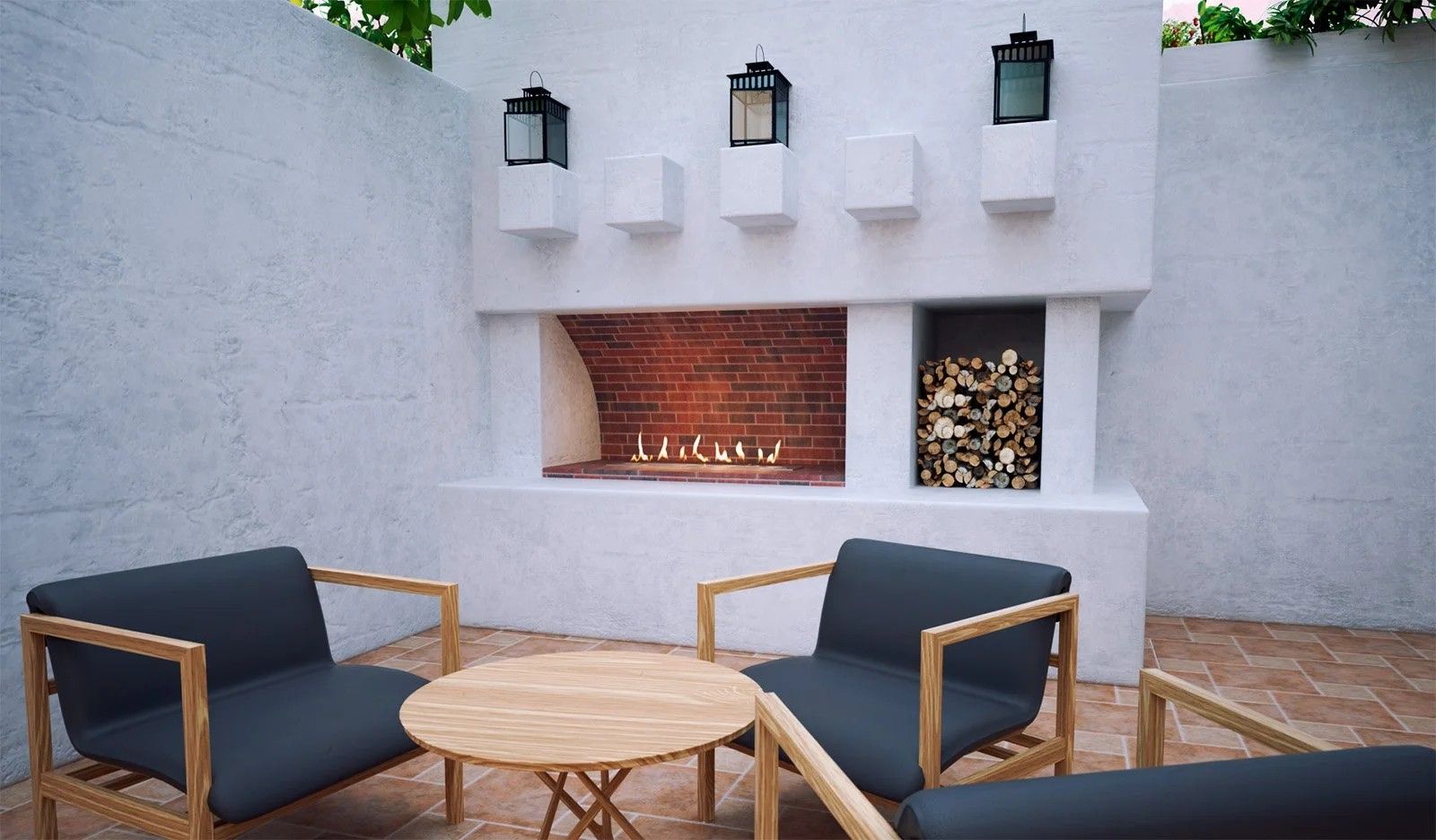
- Into a wall of stone, plaster or steel, as a long linear flame at seat height.
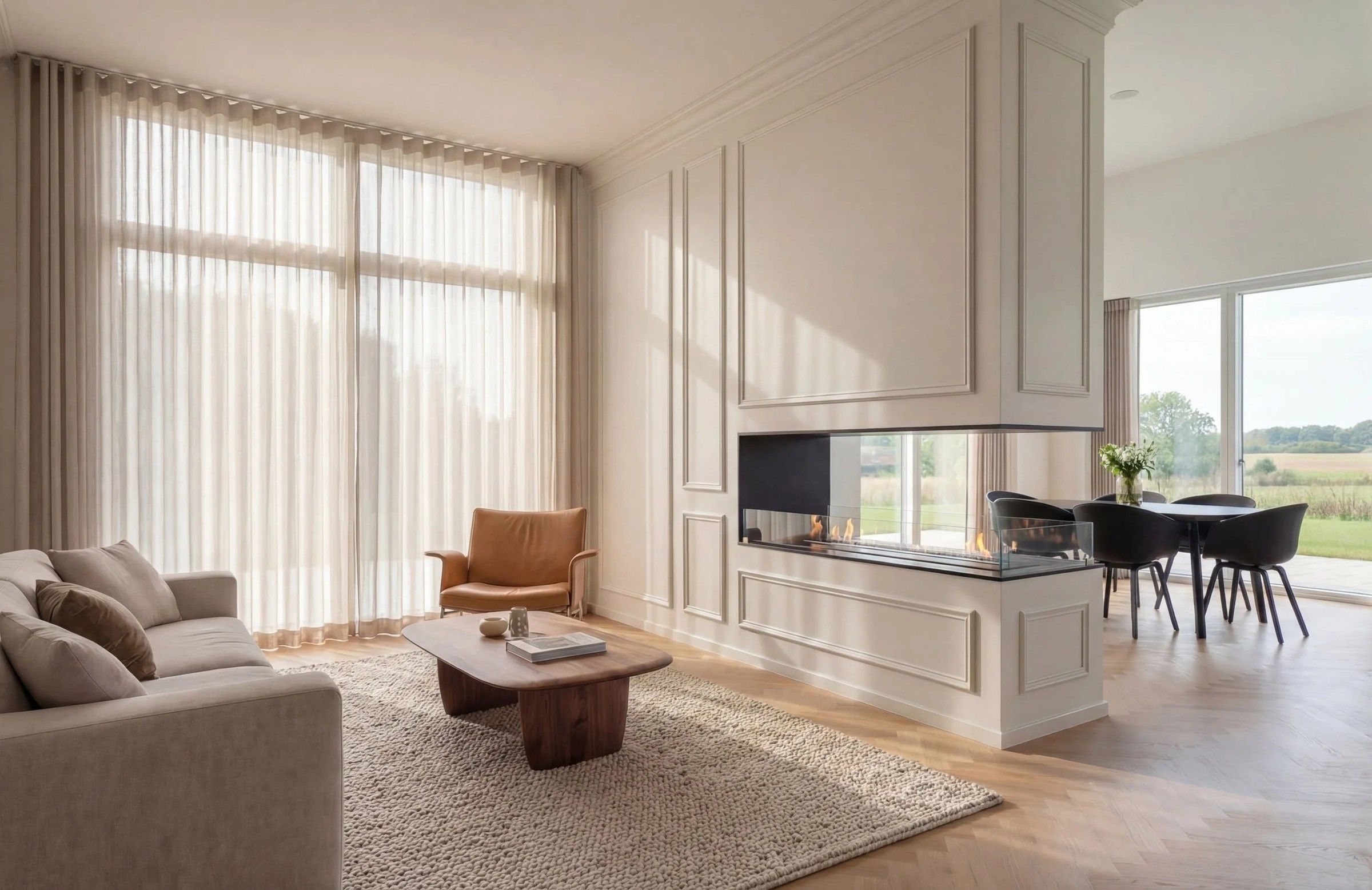
- Between two rooms, in a see-through casing, so the majlis and the dining room share one fire.
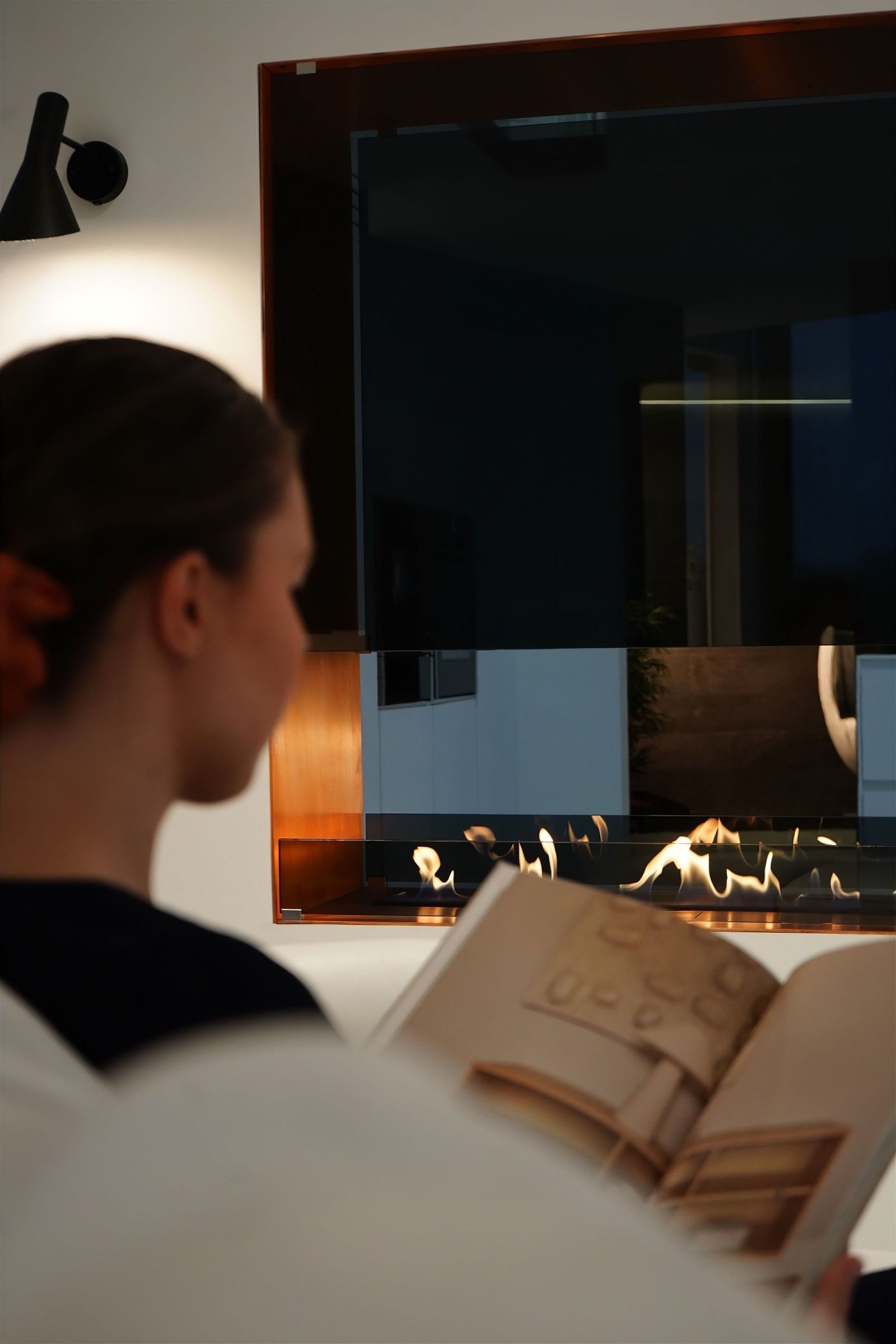
- Into a media wall, with the screen above and the flame below.
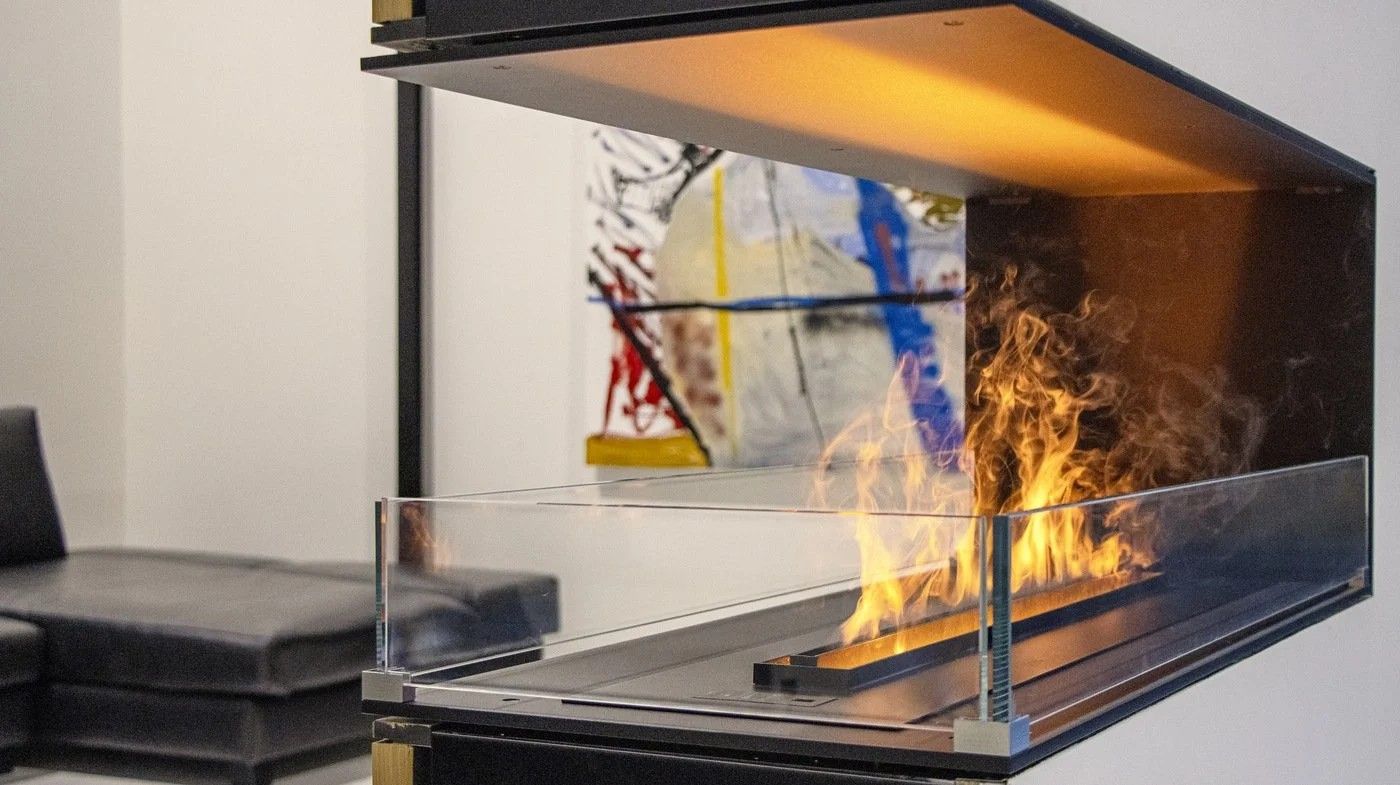
- In the middle of the room, as a room divider open on three sides, or as a freestanding or suspended piece.
- In a dining table, as a burner set into stone or joinery.
Every one of these is made to measure in Vestbjerg, Denmark, in 3 to 4 weeks of production and about 6 weeks to your door. Read how a custom fireplace is made for the steps.
The next step
Tell us the room and whether you want a real flame or the look of one. We will say honestly which option fits, send the drawing and the datasheet, and you can see the result in your own room with our visualiser before anything is made.