The short answer
Yes, a well-made bioethanol fireplace is safe to use indoors, if it is sized for the room, installed in a non-combustible surround, used with the room ventilated, and refuelled only when cold. Automatic burners add a layer of protection with sensors that stop the fire when something is wrong.
What follows is only what we can back up with Decoflame’s official datasheets, manuals and product pages. No invented certificates, no marketing claims.
What a bioethanol flame releases
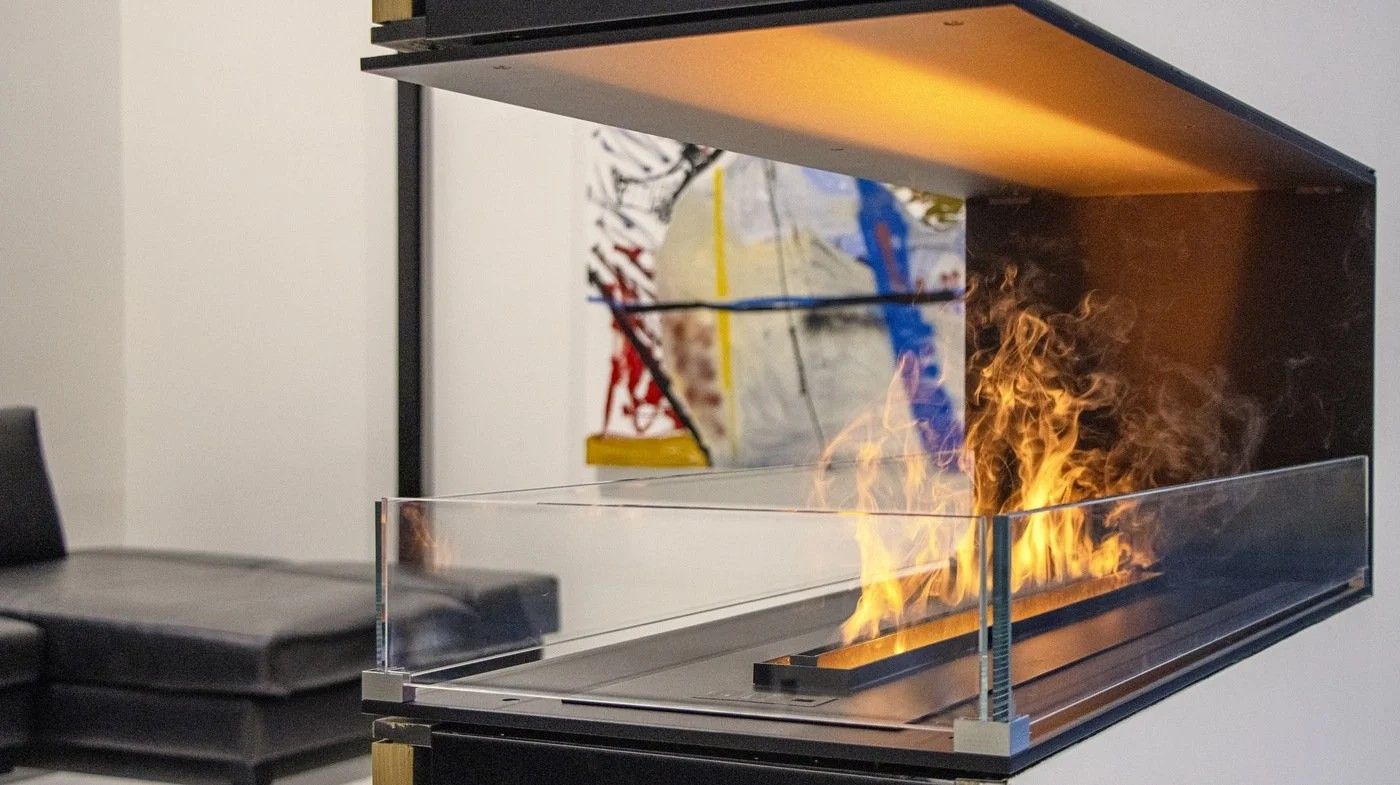
Bioethanol is a renewable, plant-based fuel. When it burns, it releases heat, water vapour and a small amount of carbon dioxide. It produces no smoke, no soot and no ash. That is why no chimney or flue is needed.
“No chimney” does not mean “no air”. Any flame uses oxygen and adds carbon dioxide to the room. So two rules follow:
- Ventilate the room while the fireplace is lit, as you would with any open flame.
- Match the burner to the room, using the minimum room volume in the datasheet.
It is also worth being clear about what a bioethanol fireplace is for. Decoflame describes its fireplaces as primarily decorative, not a primary heat source. It is there for the flame and the atmosphere.
How much room does it need?
Every Decoflame burner has a minimum room size in its datasheet. These are the published figures for three common burners:
| Burner | Fuel capacity | Burn time at maximum flame | Minimum room size |
|---|---|---|---|
| Denver F6, 1,020 mm | 6.5 L | 7.3 h | 102 m³ |
| Denver F6, 1,120 mm | 7.2 L | 7.0 h | 115 m³ |
| LogicWood Linear, 920 mm | 6.6 L | 9.5 h | 85 m³ |
To check your room, multiply its length by its width by its ceiling height. A majlis of 8 m by 5 m with a 3.2 m ceiling has a volume of 128 m³, comfortably above the minimum for a 1,120 mm burner. A small study of 4 m by 3.5 m at 2.8 m is about 39 m³, too small for these burners: that room is better suited to water vapour. We make this check for every project during the consultation.
The safety features that matter
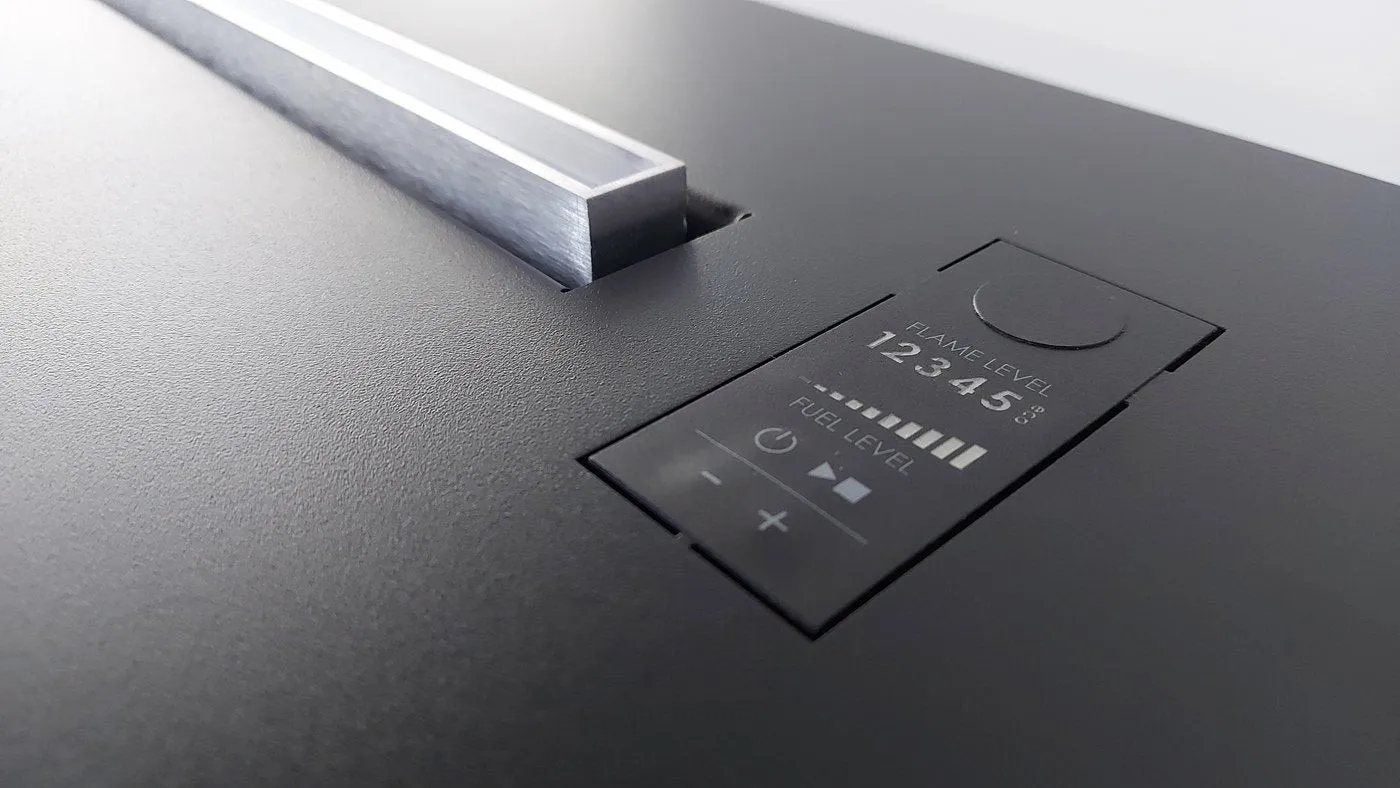
Decoflame’s automatic burners, the Denver F6 and LogicWood, are built with electronics developed in-house in Denmark. According to the official datasheets and manual, they include:
- Automatic emergency shut-off.
- A spill sensor. If a spill is detected, the fireplace will not switch on.
- A CO₂ sensor, and sensors that measure overheating and other factors.
- Controlled combustion. The Denver F6 uses CEVB technology (Controlled Ethanol Vapour Burning).
- Six flame levels, so you can keep a lower flame in a smaller space.
Automatic burners are lit from the control panel, the remote or the Decoflame app over Bluetooth. There is no need to bring a lighter near the fuel, which removes one of the most common risks of simple manual burners.
Refuelling: the moment to be careful
Most accidents with bioethanol fireplaces anywhere happen when someone refills a burner that is still hot, or pours fuel near a flame. The rule is simple: refuel only when the burner is cold, and never top up a lit fireplace.
For long burners or frequent use, the Denver F6 and LogicWood can be fitted with an optional 60 L automatic tank system, connected with 10 m of cable and hose. The fuel is stored away from the fire and fed automatically, so nobody handles fuel next to the burner.
Use the fuel recommended for your fireplace. We advise on this for every project.
The surround must be non-combustible
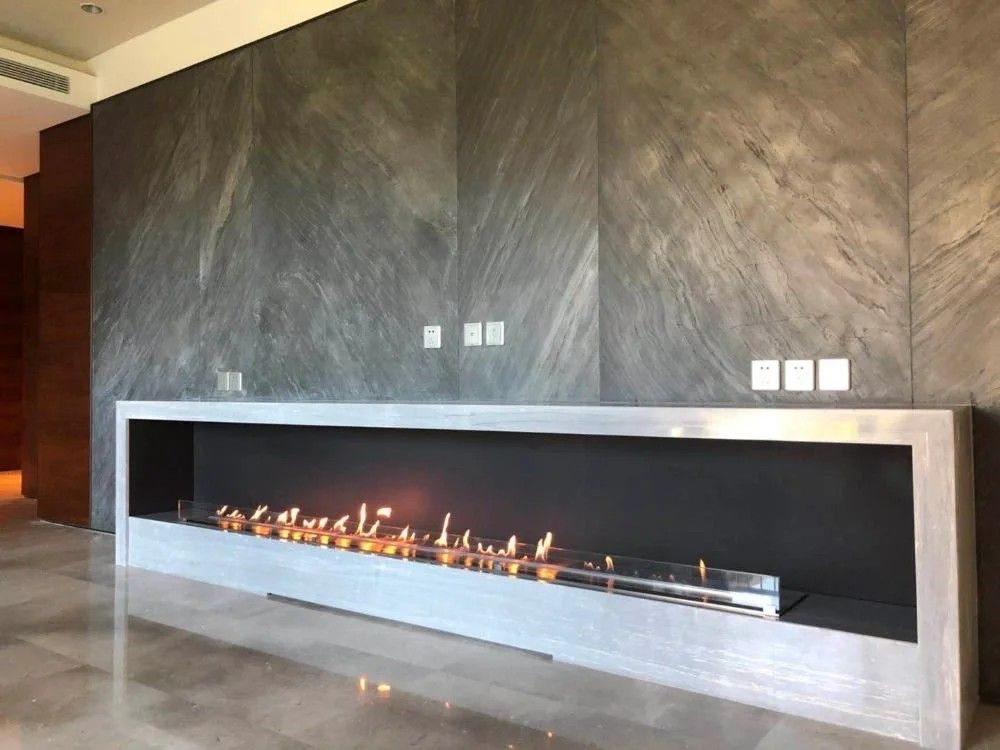
A burner is only as safe as what it is built into. Decoflame’s installation manuals specify a non-combustible surround (the manuals refer to the European classification DS/EN 13501-2 for the materials). In practice that means stone, concrete, masonry, fire-rated board or a Decoflame Montreal casing, never bare timber or fabric around the burner. Wood slat walls and joinery can still be part of the design, with the right distances and insulation, which our designers draw for you.
Certification and testing
Every Decoflame bioethanol fireplace is CE-marked, which means it complies with the applicable European standards and safety requirements, and the products are regularly tested at an approved test centre. They are designed, manufactured and quality-tested in-house in Vestbjerg, Denmark, where Decoflame has built fireplaces since 2008.
Children, pets and busy homes
The sensors protect the burner. They do not replace supervision. With young children in the house, place the fire at a height or behind glass where small hands cannot reach, and never leave a lit fire unattended.
If you would rather not think about it at all, choose a water vapour fireplace. Hybrid Mist has no flame, no heat and a surface that stays cool to the touch. We compare the two in bioethanol or water vapour: which suits your villa or majlis.
A quick safety checklist
- The room meets the burner’s minimum volume.
- The surround is non-combustible, as drawn by our designers.
- The room is ventilated while the fire is lit.
- Refuelling only when the burner is cold, or via the automatic tank.
- Children supervised; the fire never left unattended.
- Installation and servicing by our authorised team, which also keeps your 24-month warranty valid.
Where to go from here
See the burners and their safety features on our bioethanol fireplaces page, or book a private design consultation. We check the room volume, the surround and the ventilation with you before anything is made.